
How to play
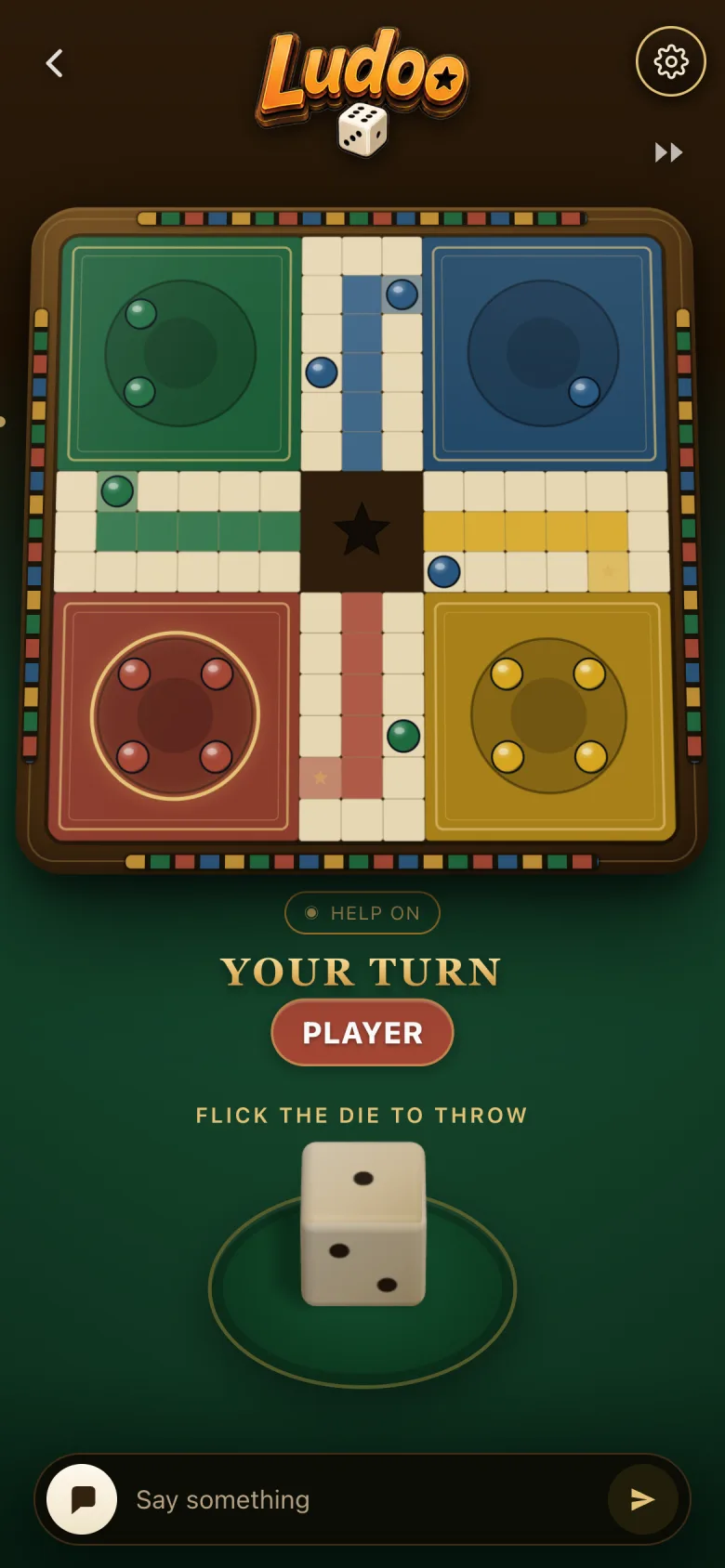
Four pieces, one lap, and a die you flick.
If you have played Ludo, you already know most of this. What follows is how Ludoo handles the parts every family argues about.
A turn
- Flick the die Drag on your phone and let go. The die travels across the glass and settles — and if it leaves the table, that throw is gone. Nobody gets a quiet re-roll.
- Bank what you throw A six earns another throw. Numbers you have not spent stay in your hand, so you can throw again before deciding what any of them buys.
- Spend a number Enter a piece, move one along, or send somebody home. The board marks every square a number can reach, and tells you why a piece cannot move when it cannot.
- Send somebody home Landing on an opponent sends that piece back to the start. There is also the sideways kick — the one your cousin insists is not a real rule.
- Get all four home Up the home lane, and exactly onto the last square. First seat home wins; the table decides whether the rest keep playing for second and third.
The parts people argue about
Each of these is a setting rather than an assumption, because every one of them is somebody's house rule and somebody else's heresy.
Three sixes
Some tables lose the whole turn on a third six. Some keep them. Ludoo treats it as a setting, because both tables exist and both are right.
The sideways kick
Kicking across a lane rather than along it. Whether it reaches one square or the whole lane changes the game completely, so it is set before the match rather than argued during it.
Adding a six to take somebody
A six may be added to the other numbers in your hand as one movement — and that movement is legal only if it lands on an opponent and takes them. It buys reach, not passage: the chain still walks every square, so a wall in the way stops it dead however well the numbers add up.
Blocks and walls
Two of your pieces on one square hold it. Whether anyone may pass a wall, and what happens when two meet, is set by the rules in force.
Off the table
A die that bounces off is a die that did not count. The physics are on your phone; the outcome is decided by the server, so the same flick is the same result for everyone watching.
The full ruling on each of these is being settled in the rules workshops — see where the rules stand.
Learn it by losing.
The characters will teach you faster than this page will.